
“Old Ordnance Building” Declared National Historic Site
274 Sydney Street, Saint John, New Brunswick
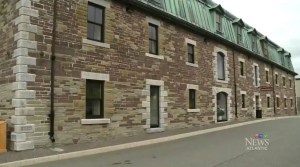
 The “Old Ordnance Building” in the south end of Saint John, once deemed surplus and left unwanted, was just declared a National Historic Site. Built in 1842, the building is a former British military depot for weapons and ammunition. It was purchase and restored by local landlord/developer Commercial Properties Limited and is now occupied by office tenants including Dillon Consulting.
Margot Sackett of the Historic Sites and Monuments Board of Canada was on hand for the announcement. “We’re looking for things that are of national significance, not regional, not provincial,” she said. “They have to stand out on a national scale, whether its people, places or events — and in this case, it’s the place.” Source: www.atlantic.ctvnews.ca
To read the entire article and access the video click HERE

Bank of New Brunswick Building… Price Reduced!
125 Prince William Street, Saint John, New Brunswick
$899,000 NEW PRICE $749,000 SOLD
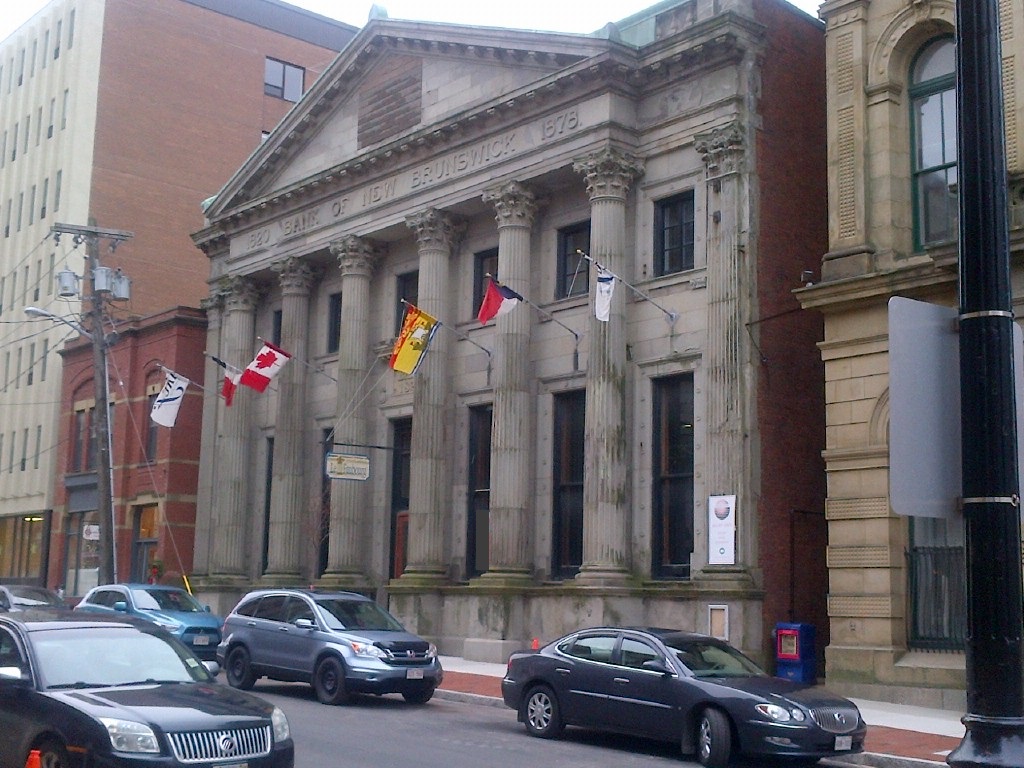 The Bank of New Brunswick Building in Saint John, New Brunswick built in 1879 is on the Registry of Historical Places of Canada. Located on the recently improved block of Prince William Street, this building has undergone extensive upgrades totaling close to 1 million dollars over the last several years.
“The Bank of New Brunswick Building is a two-storey freestone Greek Revival building with six Corinthian columns supporting a large peaked pediment over the Prince William Street façade. The building extends to a four-storey brick façade with storefront on Water Street. It is located within the boundaries of the Trinity Royal Heritage Conservation Area of the City of Saint John.” Source: www.historicplaces.ca
For more information on this opportunity click HERE
It’s a sign! Part 3 – Creative Soup

86 Prince William Street, Saint John, New Brunswick The Creative Soup Building
INTERVIEW WITH DEREK RIEDLE ABOUT THE BUILDING NAME & SIGN
Q. Is there a back story behind the name/design?
A. This building has been a labour of love since from the beginning. We wanted to create an identity for it. For a while it was called “Revolution House” but that didn’t really stick. We wanted something catchy. The list of tenants that call this property home is a very creative mix. We had been bouncing potential names around… I shouted out to Greg Hemmings “creative soup” and we both knew instantly…that was it!” Tenants in the building include: Revolution Strategy, Talons of Venice, Riedle Urban Spaces, Liquid Gold, Java Moose, Hemmings House Pictures, Kim Jakobsen Design, ArtsLink NB
Q.Did you have to get approval from heritage and was that difficult to obtain? (more…)
It’s a sign! Part 2 – Central Telegraph
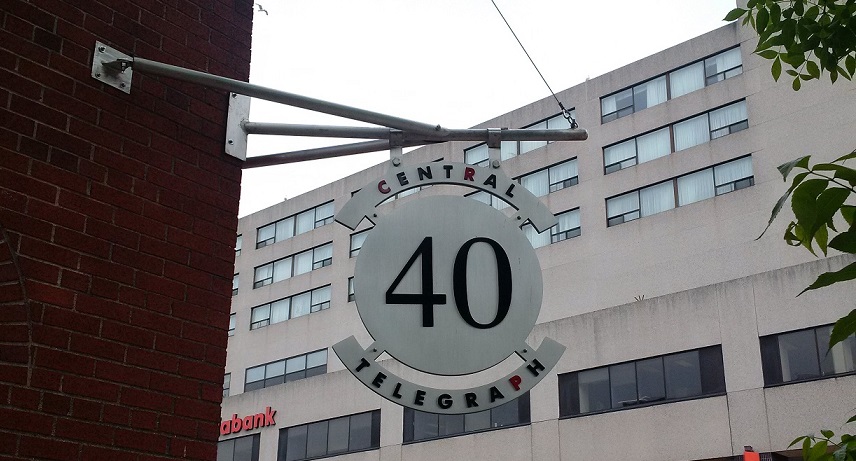
Have you noticed this sign at 40 King Street, Saint John and wondered what “Central Telegraph” means? The owner of this building put a lot of thought and resources in to the design and procurement of a class A sign for his building.
 INTERVIEW WITH OWNER OF 40 KING STREET
Q. What’s the story behind the sign?
A. The building was the site of Canadian Pacific Railroad’s telegraph office. In the old days if one wanted to send a message anywhere in world they would go to this telegraph office to do that. I wanted to have a smart looking address displayed on the building and after reviewing some old pictures (see gallery of old photos below) and the history of the building, I designed the sign concept. I also wanted the sign to be more that just an address identifier – to add something to the historical content of the area.
Q. Did you have to get approval from heritage and was that difficult to obtain? (more…)
It’s a sign! Part 1 – Elwood’s Wood Lab
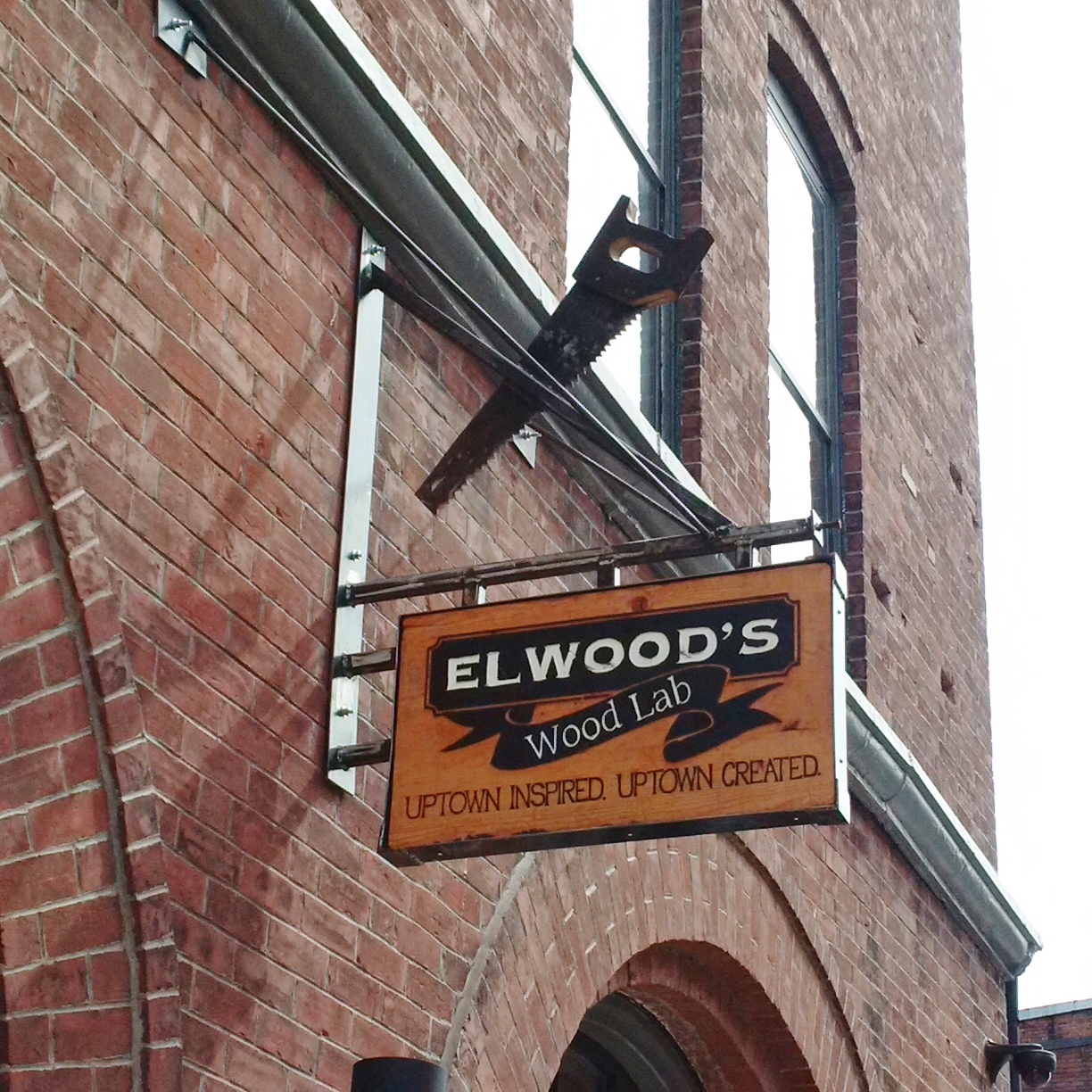
91 PRINCESS STREET, SAINT JOHN. I was so thrilled to see a cool new sign appear on Princess Street. Elwood’s Wood Lab is now open and their sign is perfect!
“We are reconstructing history from within our joinery in Saint John, NB. Using a variety of reclaimed wood and steel from around New Brunswick, Elwood’s Wood Lab creates character rich crafted furniture and lighting for customers around the world.” ~ About Elwood’s Wood Lab from their WEBSITE
Why is signage important? Your sign is part of your business’ image and a part of your branding strategy. The type of sign that you choose says a lot about your business. It conveys a message about the type of clientele that you cater to i.e. refined/upscale/hipster/young/mature.
INTERVIEW WITH ELWOOD’S ABOUT THEIR NEW SIGN
Q. Is there a back story behind the design of it?
FINDING A SPACE WHERE YOU WILL FLOURISH
 By guest blogger, Laura Lunn – Marketing Assistant/Intern
Sometimes being a commercial real estate agent is not all about filling vacancies. It’s about finding the proper tenants that will flourish in their new space.
A daycare next to a lawyer’s office might not be the best option for either tenant, so to avoid any dispute and negativity another space might be recommended, where they will feel comfortable.
If you are a Tenant in need of space Step 1. Have a read of these short “5 Tips for Tenants” that will help you begin your journey. Step 2. Call Stephanie
Source: www.bbb.org
Welcoming NBCC student Laura Lunn
 I’m thrilled to welcome Laura Lunn to our office in Saint John for a 5-week work practicum for the NBCC marketing program. The 5-week work term is the culmination of the 2 year program. We’re hoping to help Laura hone her marketing skills and to assist her in finding full time work in her field after her graduation this June.
We’ve only had her with us for a few days and she’s already helping us step up our marketing “game”. Watch for us around the uptown together over the next 4 weeks and if you are looking for someone with marketing skills…please stop us and say hello.
You’re invited to follow Laura on Twitter at @lauralunn888
or connect with Laura on LinkedIn HERE
#91KING residential design/floorplans

The sky’s the limit for this former Woolworth’s building…literally! Zoning allows for up to 20 storeys. As an added bonus there are no heritage restrictions. What is the highest and best use? The ground floor must remain commercial (think shops, restaurants etc…) but the upper floors could be just about anything. Since Saint John is already experiencing high vacancy rates in the office leasing market, residential probably makes the most sense. Just imagine apartments and/or condos overlooking King’s Square. Floorplans have been designed to show what could be done including a proposed parking garage in the basement. Check it out…
Interested in seeing this in more detail? Click to download .pdf >>> Proposed Condo floorplan
Have ideas for this building? Tweet them! #91KING
The Value of our Built Heritage
Excerpt from an essay by David Kilburn “The Value of Heritage, The Problem with South Korea”

NEGLECT & FAILURE TO ACT
“Perhaps the biggest problem of all is simply human neglect, the failure to act when the heritage from the past is in danger. Regulations alone cannot preserve culture. People need to recognize, value, and retain their heritage for it to survive.”
THE STORY OF ROME
“Witness the story of ancient Rome (Lançon 2001). In 425 AD, When the city of Rome was already over 1,000 years old, the Emperor Majorian was so concerned about the demolition of historic buildings that he decreed that any public official who authorised such work should be fined 50lb kg of gold while those of lesser ranks who were involved should be flogged or have hands amputated! Despite the decree, over the centuries that followed, most of the ancient city was steadily destroyed. The real destruction was wrought not by invading barbarians, but by the Romans themselves who gradually demolished old buildings to re-use the marble blocks, and fired classical sculptures to make lime for builders and whitewash for painters. By the time people learned to appreciate the heritage of Ancient Rome, over 90% of it was gone: Rome had become a city of tantalizing ruins.”
HERITAGE AS AN ECONOMIC ASSET
“Heritage buildings are often destroyed in urban areas based on the argument that the land needs to be put to more productive economic uses or must serve more important social needs. Yet these arguments typically ignore the simple fact that heritage is an economic asset that, properly managed, can deliver continuing streams of revenue. Part of the attraction for the millions of tourists that flock to London, Paris, Venice, and other European cities each year lies in the exploration of historic buildings, districts, and all the many other factors that are part of each city’s cultural heritage. Cultural tourism provides employment, revitalizes old districts, and generates new opportunities in trade and the service industries.”
How do tenants decide which building to take space in?
Price per square foot is a key factor but the financials are often very competitive. The decision to lease in one building versus another is often swayed by physical attributes.

Suite 101, 14 King Street. 1,842 s.f. office.
Tenants want to feel comfortable that the building they are moving to is going to be an asset to their company and that prospective employees will see it as an attractive place to work. The three key elements are:
- Amenities: The “walkability” of our uptown created by the internal pedway system means that most of the amenities that tenants want are nearby.
- Aesthetics: Saint John’s inventory of heritage buildings offer the character that many people crave such as high ceilings and exposed brick & beams. “Historic buildings have a unique appeal that new buildings cannot duplicate {on the flip side} new buildings have the long-span, light-filled, flexible footprints and modern common-area finishes that are so attractive. Many buildings built from 1960 to 1990 are caught in-between, and if they remain un-renovated, often feel trapped in time.”
- Sustainability. Only a few of buildings in Saint John are LEED certified.
Read more about what tenants want and the benefits of LEED certified buildings HERE via www.high-profile.com

